

Compactica voted most exciting innovation at CCA’s 2026 Annual Conference
“The system that we are building isn’t about removing people from the site or replacing a traditional testing method. It’s about improving the visibility of the entire operation, so the quality issues are caught and remedied while there is still a chance to do it.”
Nick Groves, Compactica
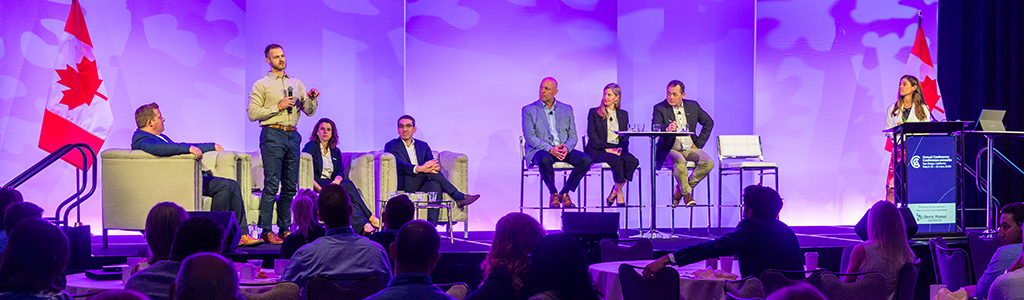
Nick Groves, Co-Founder of Compactica, was one of five innovators selected to present their solutions during the Innovators’ Pitch: CONtact mentorship session at the 2026 CCA Annual Conference in March. The session has delegates voting for their favourite innovation, and Compactica was the audience’s number one choice.
Watch Nick’s winning presentation below ↓
Compactica turns existing rollers into real-time execution tools, helping crews make compaction decisions while asphalt is still workable. Instead of relying on after-the-fact verification, teams get immediate feedback on coverage, temperature, and rolling performance to improve density consistency and protect pay factor outcomes.
CCA caught up with Nick after the conference to learn more about Compactica and his experience with the CONtact mentorship program.
CCA: How did Compactica come to be? Why this particular innovation?
Compactica emerged from a persistent challenge in asphalt compaction: teams were collecting more data than ever, yet still couldn’t explain why results varied from crew to crew, or shift to shift.
Traditional intelligent compaction systems track activity – showing where rollers went and how many passes were completed – but they stop short of connecting that activity to outcomes like density results or failed cores. That gap leaves crews guessing, with decisions often made after the fact, when it’s too late to correct issues.
The company was founded by a team with direct experience in geotechnical engineering and field compaction, who have worked within the workflows they are now improving. Through that experience, they saw that compaction is still largely managed through spot testing and delayed feedback.
Compactica was built to close that gap. The focus isn’t just on collecting data, but on connecting rolling behavior, temperature, timing, and location to actual results in real time. The goal is to give crews the ability to make adjustments during the shift, not after the report is written.
CCA: How has your participation in CONtact and pitching your solution at the conference helped you? Was there any advice or question that stood out, and how will it influence your future work?
CONtact accelerated two things for us: clarity of positioning and validation of the problem.
The most valuable feedback wasn’t about features; it was about framing. Several contractors consistently asked: “How quickly can my crew act on this in the field?” That reinforced that adoption isn’t driven by analytics depth alone, but by how quickly insights translate into action.
That feedback has influenced how we prioritize product development and onboarding. We’re doubling down on simplifying the operator and foreman experience, making sure insights are immediate, obvious, and tied to decisions that crews can make on the job.
The conference also opened direct conversations with contractors across different regions, which is critical for a solution that must adapt to real-world variability in crews, mixes, and workflows. That clarity has already translated into traction. We’ve secured pilot projects with large asphalt contractors and began converting those into paying deployments, validating both the urgency of the problem and the operational value of the system.
CCA: How does Compactica help clients reduce risk, rework, and liability exposure on projects? What do you consider the biggest ROI?
Compactica reduces risk by shifting decision-making earlier in the process. In asphalt paving, compaction performance has immediate financial impact. Crews are measured against density targets, and once the material cools, errors can’t be corrected without costly tear-out and rework. That creates a narrow window where better decisions can have real economic impact.
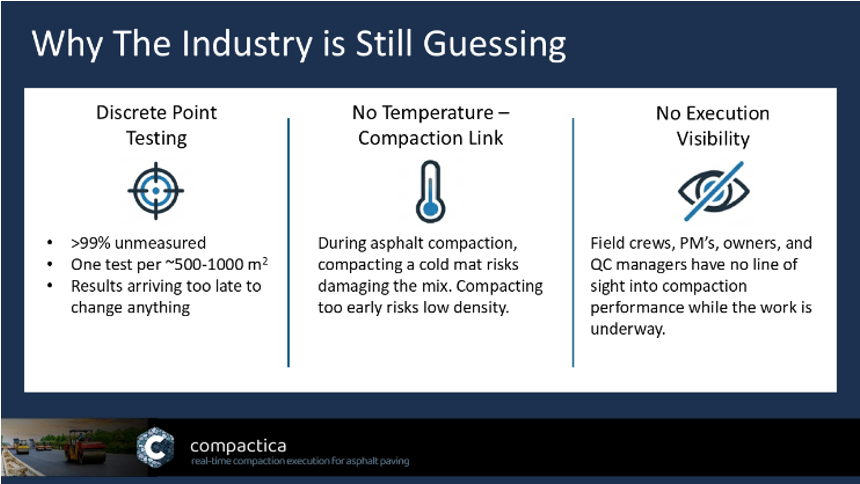
Instead of discovering compaction issues days later through core results, crews can see risk developing during the shift, such as areas where temperature drops too quickly, rolling patterns are inconsistent, or timing reduces compaction effectiveness.
This allows teams to:
- Adjust rolling patterns in real time
- Rework areas immediately while the mat is still workable
- Standardize performance across crews and shifts
From a liability perspective, Compactica also creates a structured record that connects actions taken in the field to outcomes, strengthening documentation and defensibility.
The biggest ROI typically comes from preventing rework and failed cores as well as improving consistency in achieving density bonuses. More importantly, it enables repeatability – high-performing crews can be replicated, rather than treated as exceptions.
CCA: What are the biggest barriers to adoption of intelligent compaction among contractors today, and how are you addressing them?
There are three main barriers:
- Perception that intelligent compaction is a reporting tool
Many contractors view these systems as a way to track what happened, rather than improve what’s happening. Compaction, however, is an execution problem where value is created or lost in real time. We address this by focusing on real-time feedback tied directly to actions crews can take during the shift. - Workflow disruption in the field
If a system adds friction, it won’t be used. We designed Compactica to fit into existing roles and workflows, rather than asking teams to adopt entirely new processes. - Data inputs and setup requirements
Drawings, mix data, and core results are often fragmented or delayed. We actively guide clients on how to integrate these into their workflow and demonstrate their direct impact. When teams see the value of the output, behavior starts to change upstream.
CCA: What are the next steps for your company?
Our immediate focus is on deepening adoption within existing accounts and ensuring teams are consistently using the system during live shifts.
From a product standpoint, we’re continuing to:
- Strengthen real-time feedback loops for operators and foremen
- Improve how we integrate core results and calibrate insights
- Reduce friction in project setup and data inputs
At the same time, we are expanding deployments across North America with contractors who want to move beyond passive data collection to active performance management.
CCA: Where do you see the biggest opportunity for Compactica in the next three to five years?
The biggest opportunity is in becoming the operational layer that connects field execution to performance outcomes.
In the near term, that means expanding across asphalt paving operations in North America. Beyond that, there’s a clear path into adjacent areas where similar problems exist – where data is collected but not effectively used to drive real-time decisions. This includes areas like material flow and coordination between plant production, trucking, and paving, all of which directly impact compaction outcomes.
Partnerships will also be critical, particularly with contractors scaling best practices across crews, engineering teams looking to tie specifications to execution, and technology providers where integration can strengthen the broader ecosystem.
CCA: What key messages do you want to leave with potential clients?
If you’re already using intelligent compaction, the question isn’t whether you have data, it’s whether that data is helping your crews make better decisions during the shift. If you’re not using intelligent compaction, the opportunity isn’t just visibility, it’s control over outcomes while they’re still changeable.
Most solutions in this space focus on reporting what happened. Compactica is built to influence what happens while the work is still in progress.
The goal is simple: to help your crews achieve their best possible result, every shift – not just analyze it afterward.
The Innovator’s Pitch
Conference delegates were introduced to four rising stars from the CONtact mentorship program, each showcasing their groundbreaking innovations. The session was sponsored by Liberty Mutual Canada.
Innovators:
Luke Begley, President and CEO, CircuitIQ
Nick Groves, Co-Founder, Geotechnical Research and Development Engineer, Compactica
Anne-Marie Hervieux, Vice-President, Business Development, Isobloc
Kamyab Zandi, Co-Founder, CEO and CTO, TIMEZYX
Industry experts:
Tony Bégin, Vice President, Sales and Preconstruction, CANAM
Jen Hancock, Chair, Alberta Construction Association and Vice-President, Chandos Construction
Steve Hastings, Senior Vice President, Surety | Liberty Mutual Canada
Moderator:
Isabelle Côté, President, Synergy Frameworks and Founder, BRIX
The CONtact mentorship program, presented in partnership with the National Research Council of Canada’s Industrial Research Assistance Program, helps small and medium enterprises share their innovations with industry. Through meetings with industry experts, emerging entrepreneurs and innovators are mentored in how best to refine their product or service for industry adoption. The experience culminates with a high-profile presentation to over 500 delegates at the CCA Annual Conference.